Festival
Deepavali
The festival of lights
Festival
The festival of lights
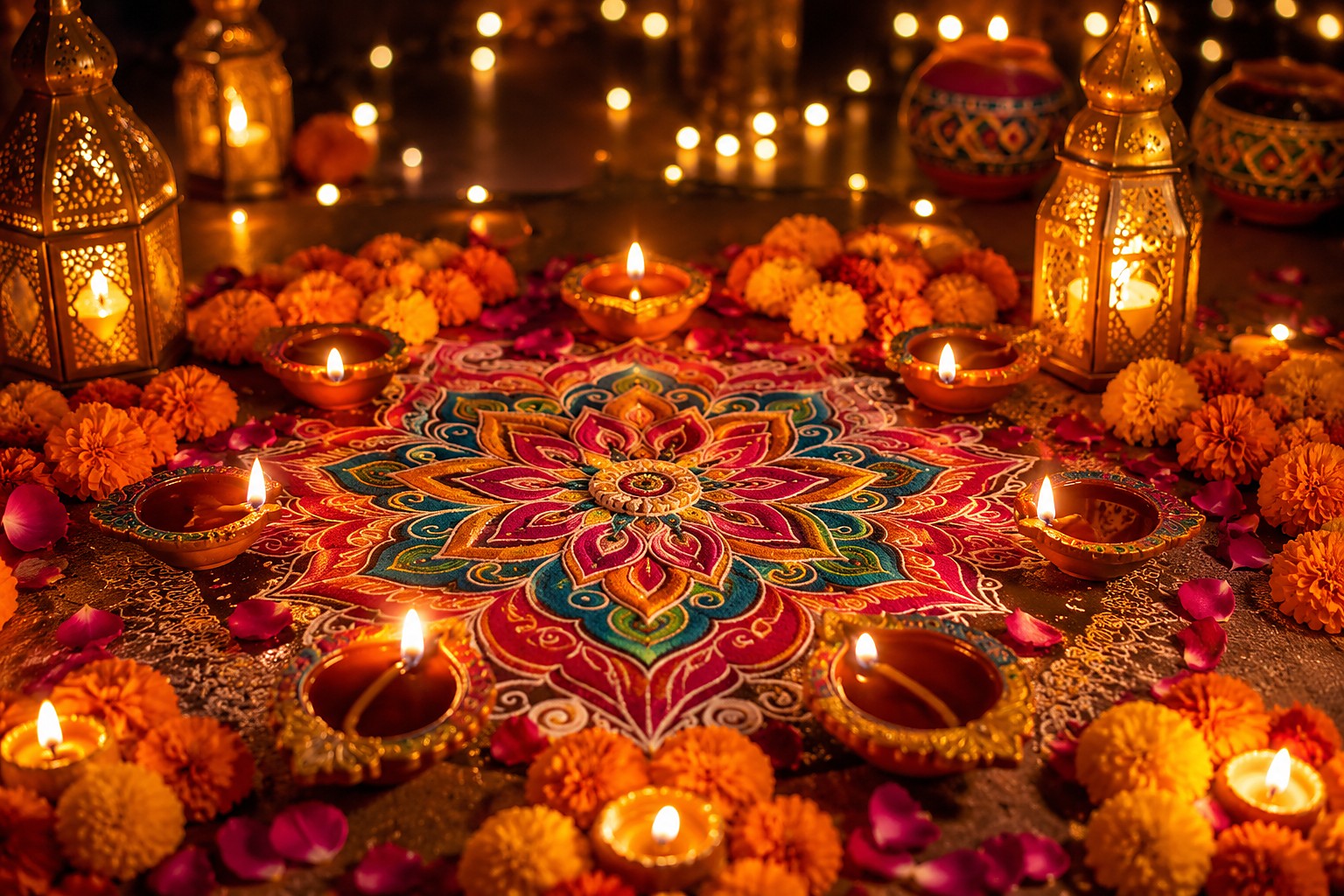
Deepavali comes from deepa, a lamp, and avali, a row — a row of lights. Rows of small oil lamps lit outside homes are the image most associated with the festival, and the shortened form Diwali is used just as widely as the fuller Deepavali.
The festival is commonly observed over five days, each with its own name and customs.
Unusually among festivals, Deepavali is not celebrated for one reason. Several distinct traditions fall on the same days.
In much of north India it marks the return of Rama to Ayodhya after his years of exile. In much of south India it marks Krishna's defeat of Narakasura — which is why one of the days is called Naraka Chaturdashi. In western India the emphasis often falls on Lakshmi and on the start of a new business year, with account books blessed. In parts of eastern India the days center on Kali Puja and on remembrance of ancestors.
These are not competing versions of one story. They are separate traditions that share a season and a symbol.
Sikhs observe these days as Bandi Chhor Divas, marking Guru Hargobind's release from imprisonment at Gwalior and his return to Amritsar — an observance recorded from the eighteenth century onward.
Among Jains the festival is associated with Mahavira and is sometimes called Deva Diwali, marked by recitation of scriptures and the lighting of homes and temples.
Because the festival crosses religions and regions, greetings and customs vary widely between families.
The days carry different names in different places. Dhanteras opens the sequence in many regions. The second day appears as Naraka Chaturdashi, Choti Diwali, Roop Chaturdashi or Kali Chaudas. The third is the main night of lamps and, in many homes, Lakshmi Puja. The fourth and fifth are variously observed as Govardhan Puja, Padwa and Bhai Dooj.
The common thread across all of them is light: lamps lit against the dark of the new moon.